The Science of the Next Quest
What happens when AI meets decades of research into how children develop, learn, and remember?
September 8, 2026
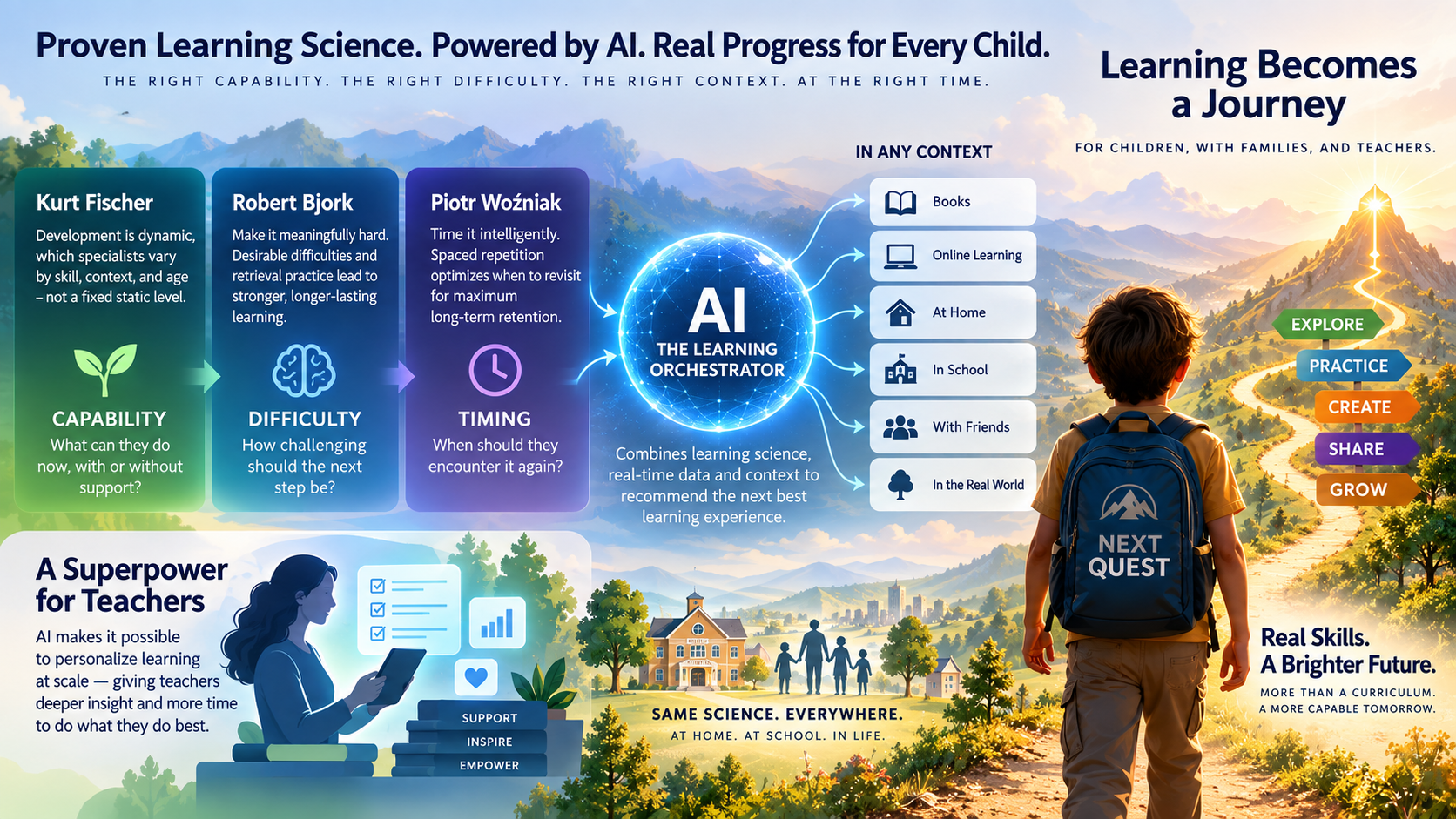
I think there may be something very big hiding at the intersection of AI and several decades of learning science.
Three thinkers in particular keep coming together for me.
Kurt Fischer, the Harvard developmental psychologist, challenged the idea that a child exists at a single, fixed "grade level." His Dynamic Skill Theory described development as much more fluid. What a child can do depends on the skill, the context, the support available and where they are in their development.
In other words: a child isn't simply "at fourth grade math."
Their capabilities form a dynamic landscape.
Robert Bjork, the UCLA cognitive psychologist, explored another part of the problem: how learning becomes durable.
His work on "desirable difficulties" showed that making learning easier doesn't necessarily make learning better. Retrieval that requires some effort can produce stronger long-term learning than repeatedly practicing something while it's easy.
The question becomes:
How hard should the next challenge be?
Then there's Piotr Woźniak, the researcher and creator of SuperMemo.
Beginning in the 1980s, Woźniak experimented with the mathematics of forgetting and reinforcement. His work on computational spaced repetition attacked a deceptively simple problem:
When should you encounter something again?
Not too soon, when repetition adds little.
Not too late, when you've completely lost it.
But around the point where retrieving it becomes difficult enough to strengthen the memory.
Now overlay these ideas.
Fischer helps us think about capability.
Bjork helps us think about difficulty.
Woźniak helps us think about timing.
And then add AI.
Suddenly we can imagine maintaining a dynamic model of an individual child's learning and continuously asking:
What capability should we exercise next? At what difficulty? In what context? And when?
None of this replaces teachers.
In fact, I think it potentially gives great teachers a superpower.
A great teacher already tries to understand which child needs reinforcement, who needs a harder challenge, who needs something explained differently and who should simply be left alone because they've got it.
The problem is scale.
Doing that continuously for 20 or 30 individual children, across hundreds of skills and thousands of learning interactions, is nearly impossible.
AI changes the economics of personalization.
It could give teachers—and parents—the ability to apply these ideas continuously, both in the classroom and at home.
And then comes the piece I'm particularly interested in:
What if we gamify the entire system for families?
A math problem can be a learning event.
But so can reading a book. Cooking dinner. Building a Lego machine. Visiting a museum. Practicing piano. Playing baseball. Helping a younger sibling. Or explaining something you just learned to Dad.
The AI doesn't have to be the teacher.
It can be the orchestrator—quietly understanding the child's evolving capabilities and helping parents, teachers and kids choose the next valuable experience.
Then the family doesn't experience any of this as an optimization algorithm.
They experience it as:
What's our next quest?
That feels like a very different vision for AI and education.
And I think we're only beginning to understand what's possible.
Share this post