Rewards or Bribes
Is QuestHouse About Bribing Kids?
June 26, 2026
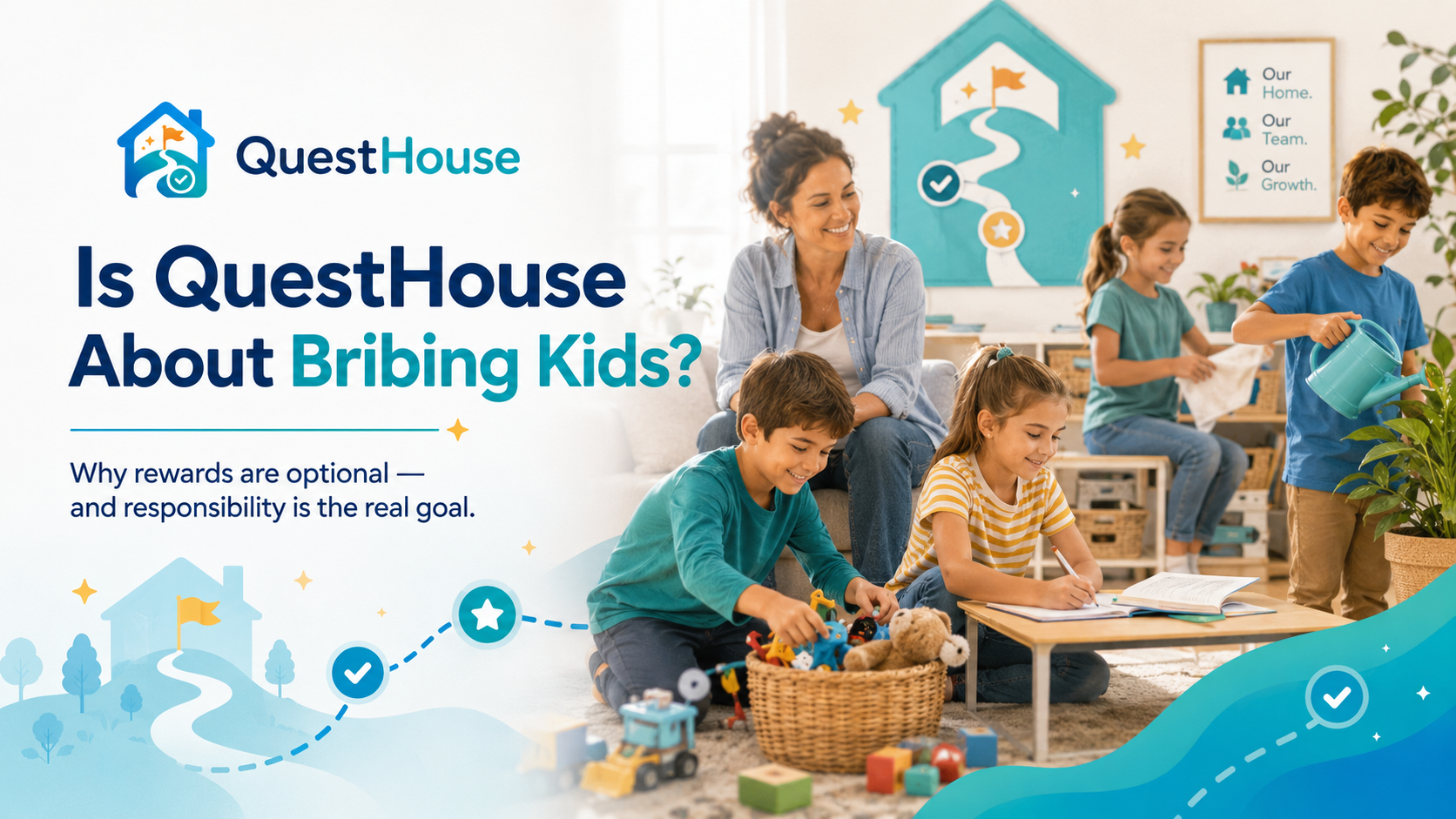
One of the first pieces of feedback I got on QuestHouse stopped me in my tracks.
A parent who had agreed to test the app told me, very plainly, that she does not believe in allowances or rewards for kids’ behavior — especially when the behavior is table stakes for living in the home.
In other words: Why should a child be rewarded for doing what they should already be doing?
Fair question.
And honestly, I agree with the concern.
I don’t want to build a bribery machine. That was never the point.
QuestHouse started because I was trying to solve a real problem in my own home. As a busy dad of six kids, I found that nights could easily turn into nagging, arguing, negotiating, reminding, and repeating the same basic instructions over and over again.
Pick that up.
Did you do your reading?
Please clean your room.
Did you brush your teeth?
Can you help with the dishes?
Why is this still on the floor?
The problem wasn’t that the kids were bad. The problem was that the system was bad.
Or maybe more accurately, there wasn’t really a system at all.
So I started experimenting. I turned chores, learning tasks, and responsibilities into quests. I gave the kids a visible path. I tied certain tasks to rewards that actually mattered to them. And the change was immediate.
The energy shifted from arguing about what had to be done to asking what else they could do.
That was powerful.
But the feedback from this early parent reminded me of something important: not every family thinks about rewards the same way.
Some families use allowance. Some families use screen time. Some families use privileges. Some families use badges, points, and recognition. Some families do not believe children should be externally rewarded for ordinary household responsibilities.
And that last group is not wrong.
In fact, they are pointing to something important. There is a real difference between saying:
“Do this because I’ll pay you.” and saying: “You are part of this family, and this is how we contribute.”
The first can become transactional.
The second builds identity.
That distinction matters.
A household should not become a miniature gig economy where kids only help if there is a payout attached. Parents should not have to bid against their own children to get basic responsibilities done. And children should not learn that every useful action requires a prize.
That is not the product I want to build. The deeper idea behind QuestHouse is not rewards.
It is responsibility.
It is visibility.
It is progress.
It is helping kids understand that they are active contributors to the home, not passive consumers of it.
Rewards can be part of that. But they are not the whole point.
For some families, rewards will be allowance or a trip to the store. For others, rewards will be screen time, choosing the movie, a special outing, or staying up a little later. For others, the reward may simply be recognition, a badge, a streak, or the satisfaction of completing a goal.
And for some families, there may be no reward attached to household responsibilities at all.
That should be supported too. QuestHouse needs to respect the philosophy of the parent.
That is one of the things I’m learning as I build it. The app should not force one parenting theory onto every household. It should help parents create structure around the values they already have.
If your family believes chores are paid work, QuestHouse should support that.
If your family believes chores unlock privileges, QuestHouse should support that.
If your family believes chores are simply part of being in the family, QuestHouse should support that too.
The common thread is not the reward.
The common thread is turning vague expectations into clear, visible, achievable quests.
Kids do better when they know what is expected.
Parents do better when they are not forced to become full-time reminders.
Families do better when progress is visible.
And this extends beyond chores.
QuestHouse is also being built around learning. I’ve been fascinated by the potential of individually tailored AI assessments and learning plans — the kind of personalization we are starting to see in new models of education.
The same principle applies there.
A child should not just be told to “do math” or “read more.” They should have a path.
Where are they strong?
Where are the gaps?
What is the next right challenge?
What can they complete today?
How does the parent know they are actually making progress?
That is where I think QuestHouse becomes much more than a chore app.
It becomes a family growth system.
Chores, learning, life skills, habits, and responsibilities can all become part of a child’s quest path. Parents can set the goals. Kids can see the missions. Progress can be tracked. Completion can be approved. Rewards, if used, can be customized around each family’s values.
But the product has to be bigger than “do this, get that.”
The better frame is: “Here is how we grow in this house.”
Share this post