Beyond “Grade Level”: A Better Way to Understand How Children Grow
A better way to track the development of children.
August 26, 2026
For generations, parents and schools have relied on a familiar question:
What grade level is this child at? (take a free assessment: https://www.questhouse.ai/freeassessment )
It sounds practical. It sounds objective. And sometimes it can be useful as a shorthand.
But Harvard developmental psychologist Kurt Fischer spent much of his career helping educators understand why that question is also deeply incomplete.
Fischer’s work showed that children do not develop in a neat, straight line. Their growth is dynamic, uneven, and highly dependent on context.
A child may show one level of skill in one setting, a different level in another, and a higher level still when given the right support.
That means a single label like “third-grade reading level” may tell us something — but it rarely tells us enough.
Development is more like a range than a fixed point
One of Fischer’s most important contributions was the idea that development should not be understood as one stable level that defines a child.
Instead, a child’s abilities often exist within a developmental range.
For example, a child may be able to:
- solve some problems independently
- solve harder problems with guidance
- show stronger understanding in conversation than on a worksheet
- demonstrate knowledge one day and struggle to access it the next
This does not mean development is random. It means development is alive.
Children are influenced by:
- prior knowledge
- confidence
- emotional state
- context
- support from adults
- the way a question is asked
- how familiar or meaningful a task feels
In other words, performance is not just a trait of the child. It is also a result of the **fit between the child, the task, and the environment.
Why “grade level” often hides what matters most
Grade-level labels are useful for organizing schools and setting broad expectations. But they flatten the picture.
When we say a child is “on grade level,” we often lose the more useful questions:
- Which specific skills are solid?
- Which are still emerging?
- Where does the child need support?
- What can they do with help that they cannot yet do alone?
- What are they ready to learn next?
A child may be advanced in reading comprehension but still developing fluency.
Another may be strong in mathematical reasoning but weak in calculation accuracy.
Another may have deep scientific curiosity but struggle to express ideas in writing.
A single grade-level label does not capture that.
Fischer’s work points us toward a more helpful model: track capabilities, not just categories.
A better question: What can this child do now?
Instead of asking only whether a child is “at grade level,” we can ask:
What can this child do independently, what can they do with support, and what is emerging next?
That shift changes assessment in an important way.
It moves us away from ranking and toward understanding.
It helps parents and educators see development as a process rather than a verdict.
And it opens the door to a more actionable kind of progress tracking.
What better assessment could look like
A more useful approach to assessment would track children across specific skills and developmental steps**, not just broad grade bands.
For example, instead of one overall label in math, a child’s progress might be tracked across areas like:
- number sense
- place value
- computation
- fractions
- geometry
- algebraic reasoning
- problem solving
And instead of reporting a child as simply “below” or “above,” we could describe progress in a more human way:
- Not yet demonstrated
- Emerging
- Developing
- Consistently demonstrated
- Ready for the next challenge
That kind of language reflects growth better than a single score.
It also makes it easier to answer the question parents care about most:
What should we do next?**
Progress should be tracked over time — not just against the average
Another implication of Fischer’s work is that progress matters just as much as comparison.
Two children can receive the same score while having very different learning stories.
One may be stagnant.
Another may be making rapid gains.
A grade-level label can miss that difference entirely.
That is why longitudinal tracking matters.
A better system would not only ask:
How does this child compare to a benchmark today?**
It would also ask:
How has this child changed over the last month, quarter, or year?
That kind of view helps us notice:
- persistent strengths
- recurring gaps
- newly emerging capabilities
- whether support is helping
- whether a child is ready to move forward
It gives parents and teachers something much more valuable than a static label: it gives them a direction of growth.
Children don’t grow evenly — and that’s normal
One of the most reassuring implications of developmental science is that uneven growth is not a sign that something is wrong.
It is usually a sign that the child is human.
Children often grow in bursts.
They may plateau in one area while advancing in another.
They may look “behind” on a narrow benchmark while making important gains in attention, confidence, language, or executive function.
Fischer’s work reminds us that development is constructed over time, often through real experiences, relationships, and guided practice.
That should make us careful about overinterpreting a single score or a single bad day.
A better progress model would leave room for that complexity.
What parents and educators may need most
In practice, most families do not need more labels.
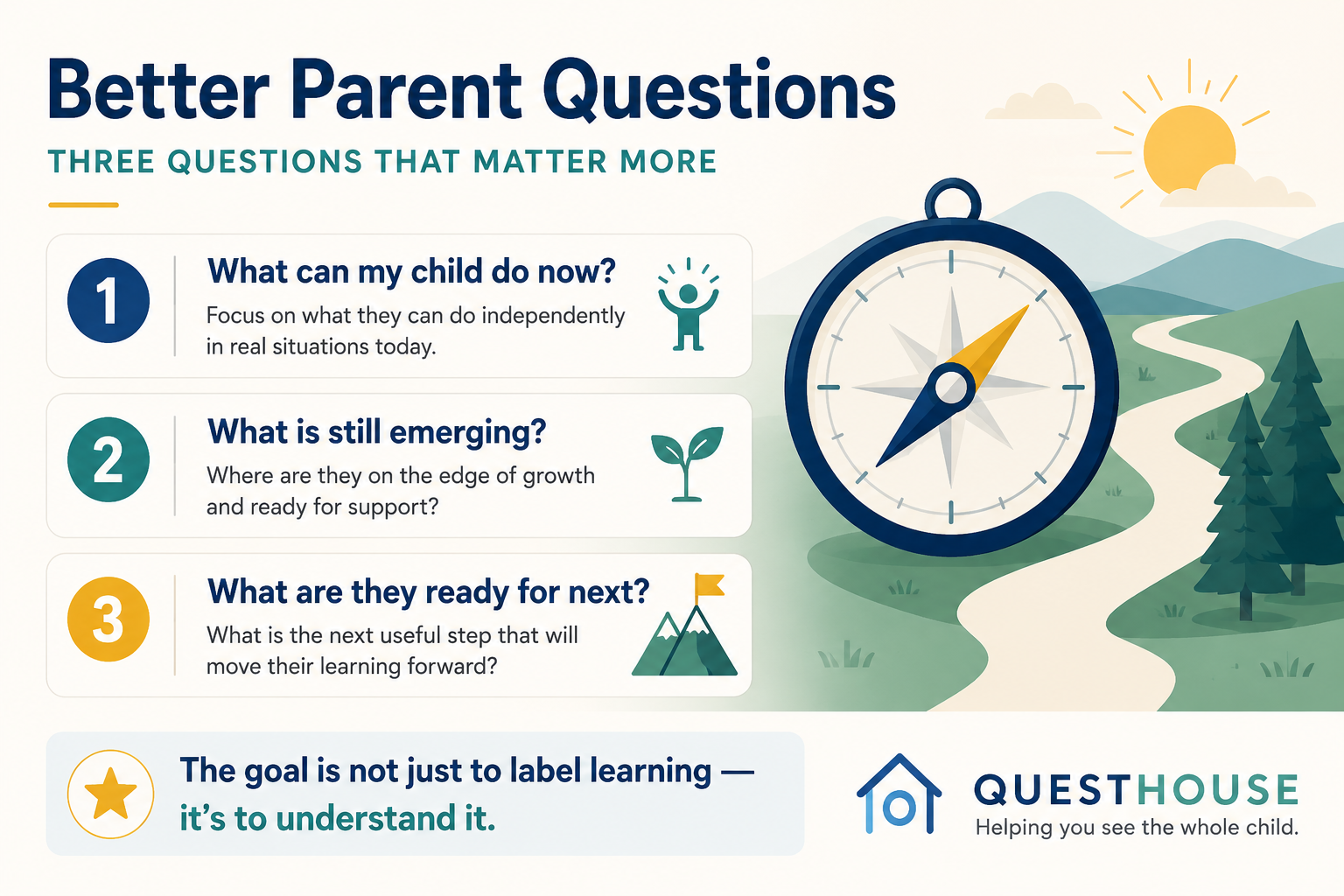
They need clearer answers to three questions:
- What can this child do right now?
Not in theory. Not compared to an average. In reality.
- What is emerging but not yet solid?
Where is the child on the edge of growth?
- What should come next?
What is the next useful step, not just the next page in a sequence?
That is the kind of information that turns assessment into support rather than stress.
Beyond grade level
Grade levels will probably remain part of education. They provide shared expectations and rough reference points.
But if we want a fuller picture of a child, they cannot be the whole story.
Kurt Fischer’s work helped show that development is not a single line and not a single number. It is a moving pattern of capabilities shaped by context, support, and time.
So perhaps the better goal is not to find a more precise way to label a child by grade.
Perhaps the better goal is to build better ways to see:
- what the child can do
- what evidence we have
- how that is changing
- and what they are ready for next
That is a more faithful picture of learning.
And it is a more hopeful one, too.
Share this post